AT-R.1 / Research / 2024
Plastiglomerate to Plastic Futures
Material Fieldwork / Anthropocene Futures
A local future research project tracing plastiglomerates from Thames River fieldwork to public material literacy, plastic futures, and speculative adaptation scenarios.
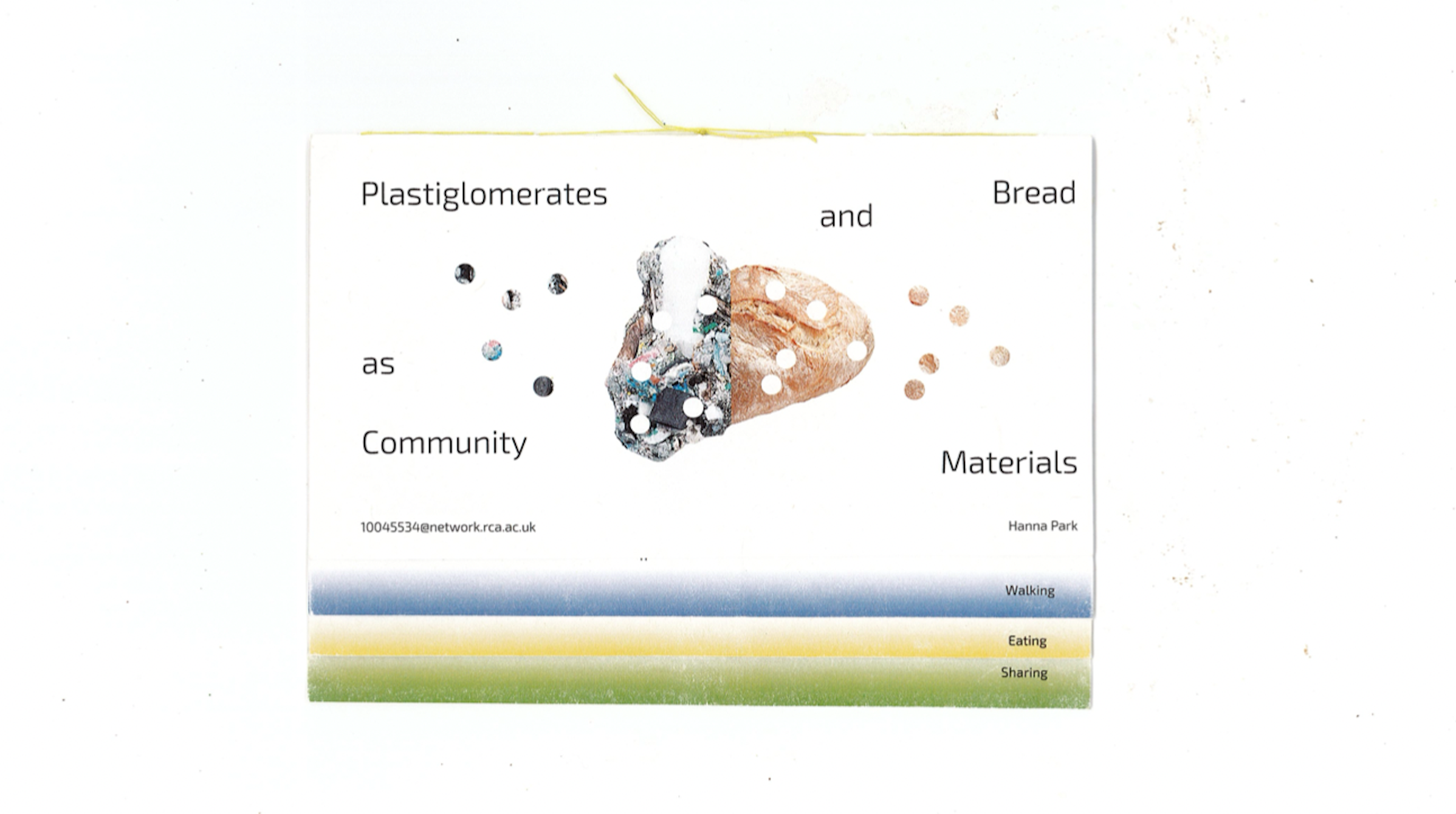
Copy of Plastiglomerates archiving book, Materiality & Embodied, RCA, 2024
Research Overview
Plastiglomerate to Plastic Futures is a local future research project that begins with walking, collecting, and observing along the Thames River.
Rather than approaching plastiglomerate as an artistic material alone, the project investigates it as a local signal of the Anthropocene: a material condition through which plastic, stone, shell, bone, sand, organic matter, and urban residue become entangled. The Thames is treated not simply as a site of collection, but as a living archive of environmental transformation.
During the fieldwork, I collected natural objects shaped by urban and riverine conditions. These included stones eroded by currents, shells with altered surfaces, fragments of bone, and ambiguous materials whose origins were difficult to classify. Although many of these objects appeared natural, their forms had already been transformed by the city, the river, pollution, weathering, and human activity.
The project asks how local communities might begin to recognise, discuss, and respond to the materials of the future before they become distant planetary abstractions.
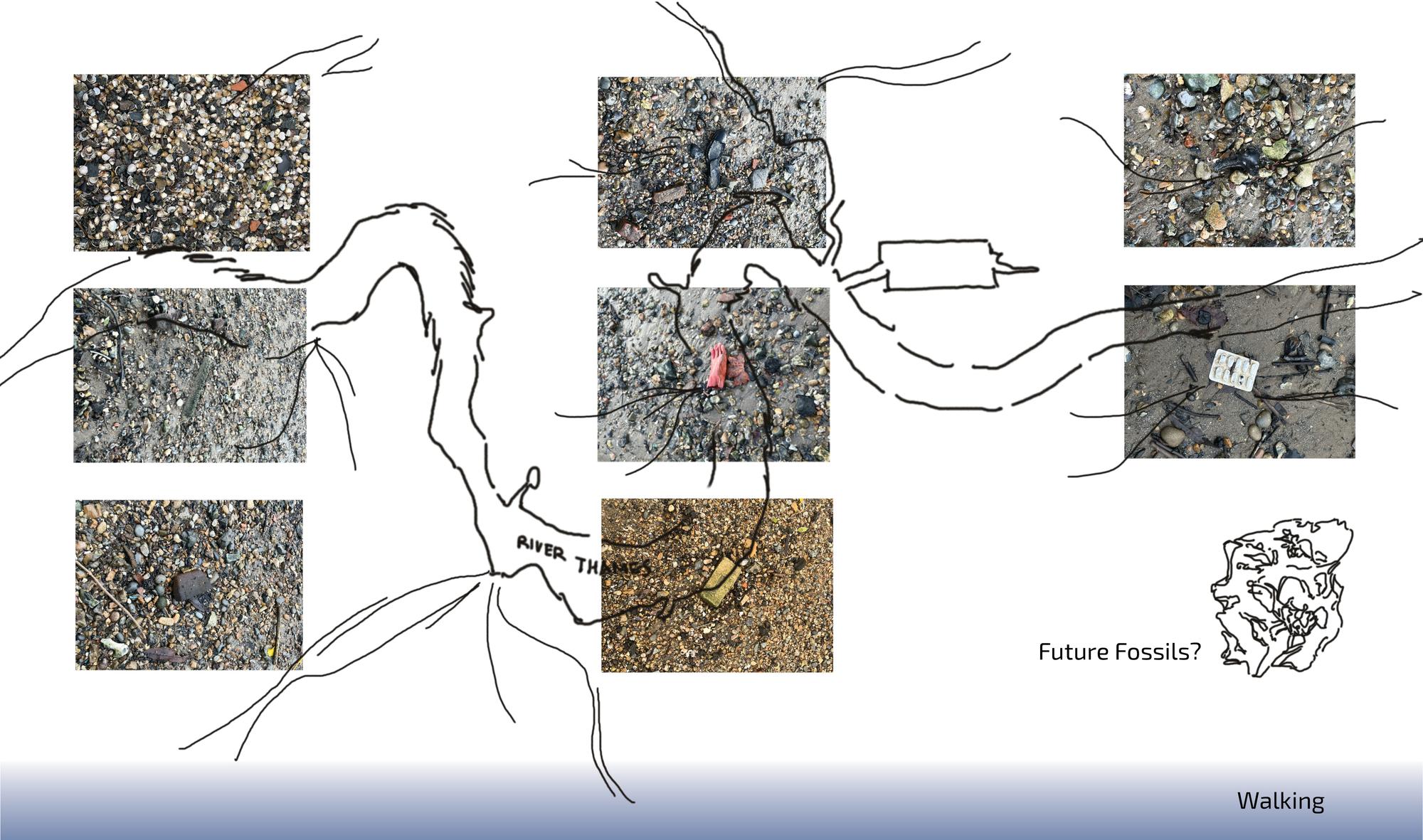
Thames River fieldwork and collected material observations
Local Material Archive
The first phase frames plastiglomerate as a community material.
Plastiglomerates are formed when plastic melts and bonds with rock, sand, shell, clay, and organic matter. They are neither purely synthetic nor purely natural. Instead, they reveal a condition in which human-made waste and nonhuman matter become materially inseparable.
In this project, the collected Thames materials became a way to understand plastiglomerate before physically encountering it as a fixed category. Walking, gathering, sorting, and observing allowed the riverbank to be read as a speculative material archive. Each fragment suggested a different relationship between geology, pollution, urban life, and ecological persistence.
The archive was not intended to aestheticise pollution. Its purpose was to make plastic futures locally legible: to show how the long afterlife of plastic is already embedded in nearby landscapes, riverbanks, and everyday environments.
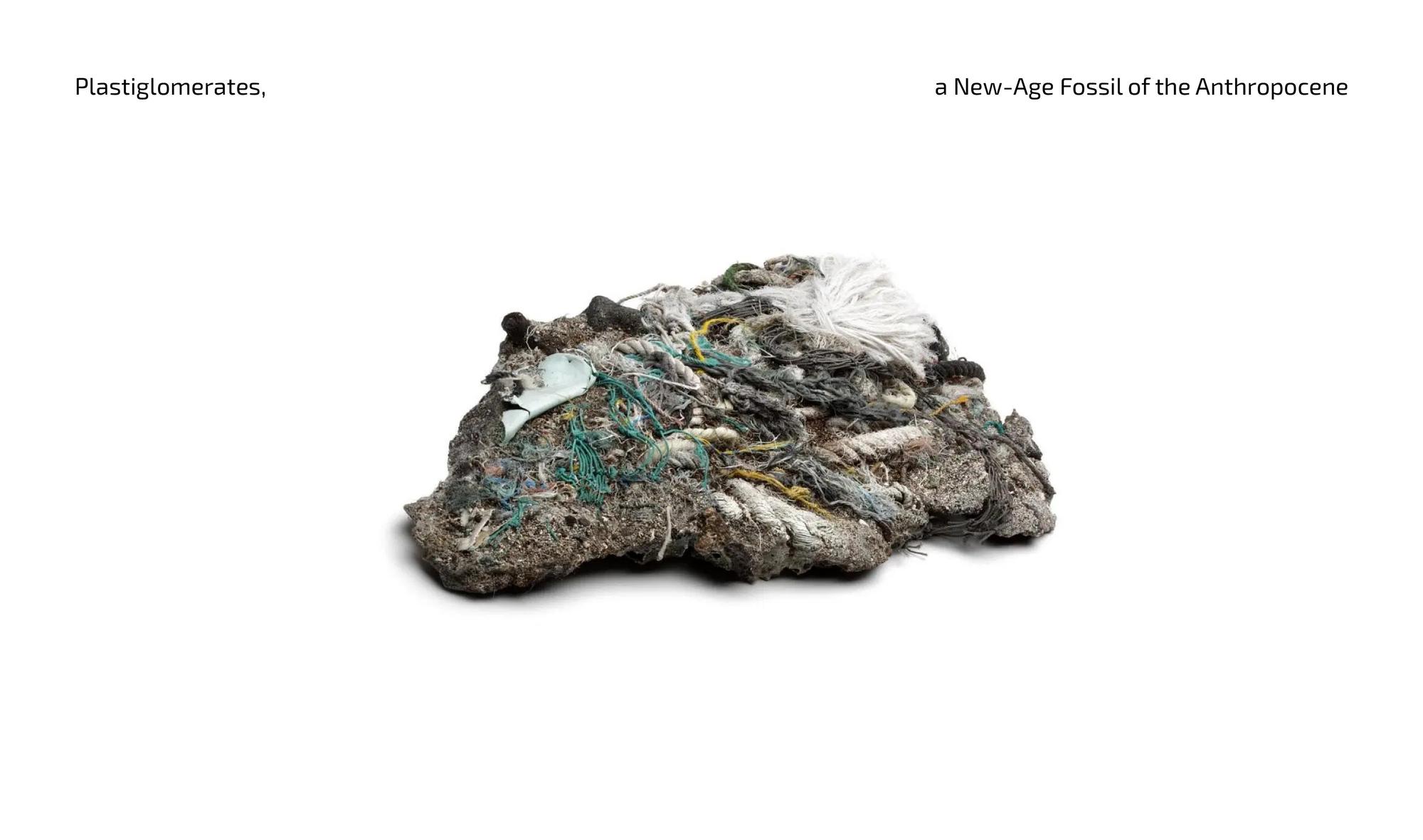
Material archive exploring natural and artificial fragments along the Thames
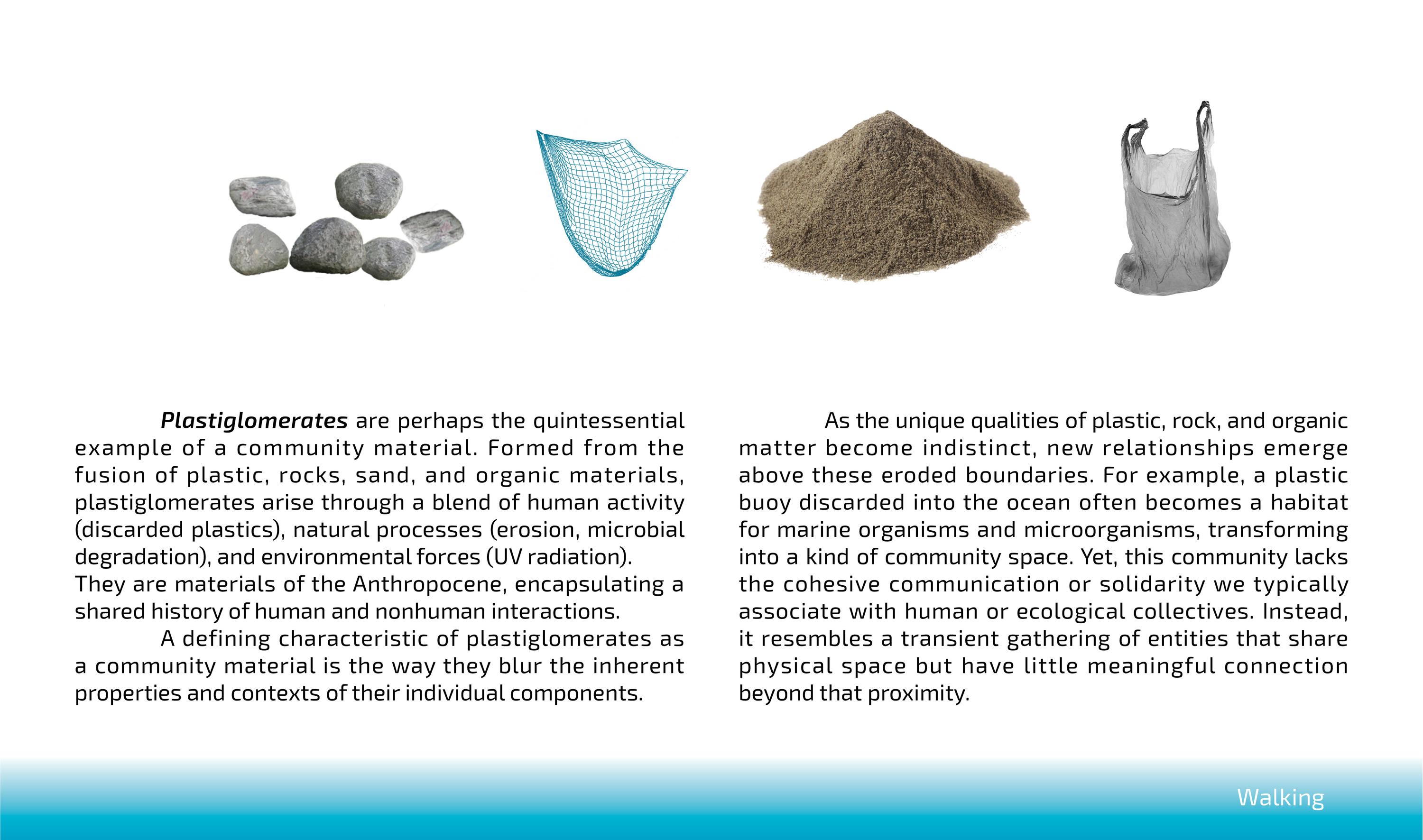
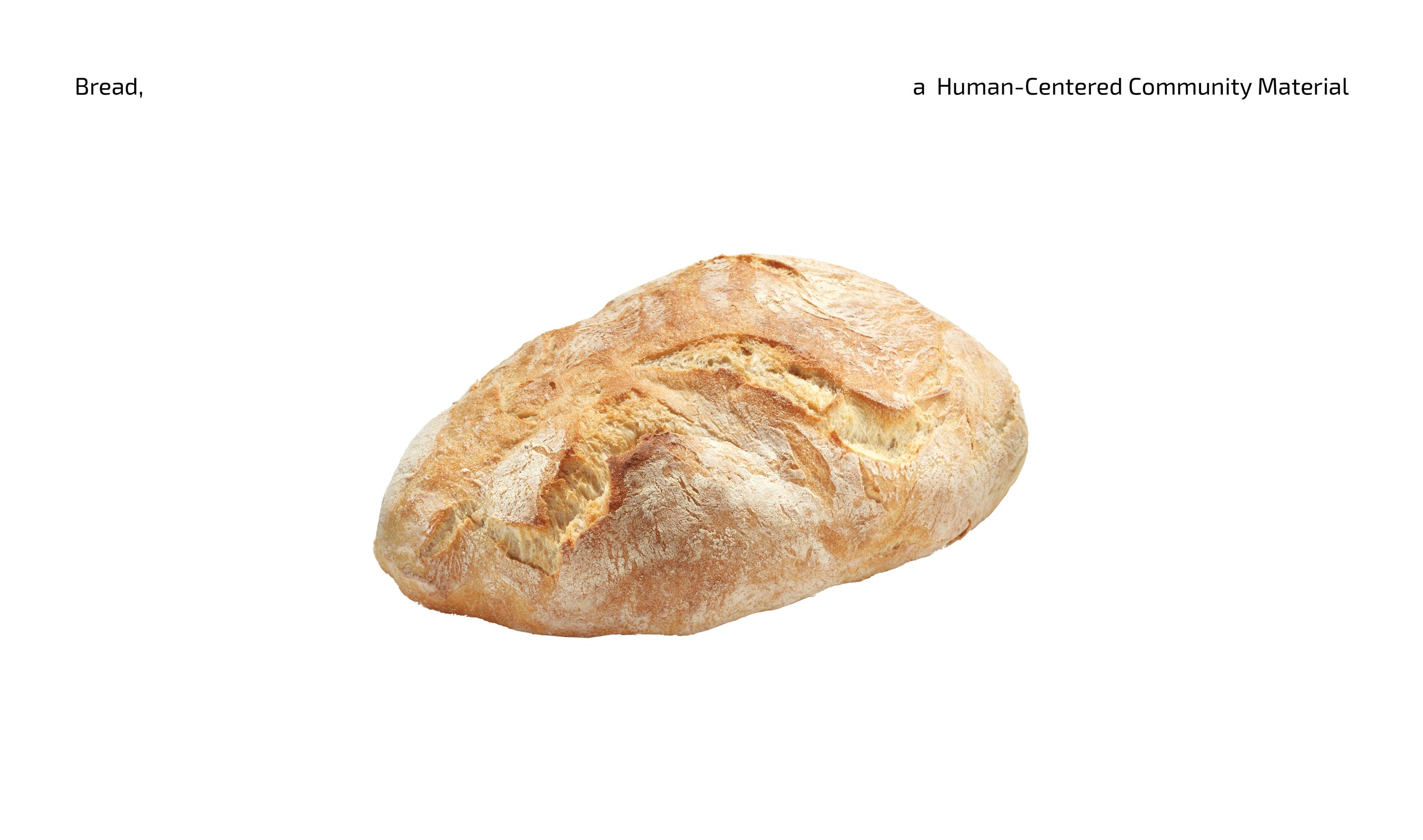
Bread as an intentional community material and public translation method
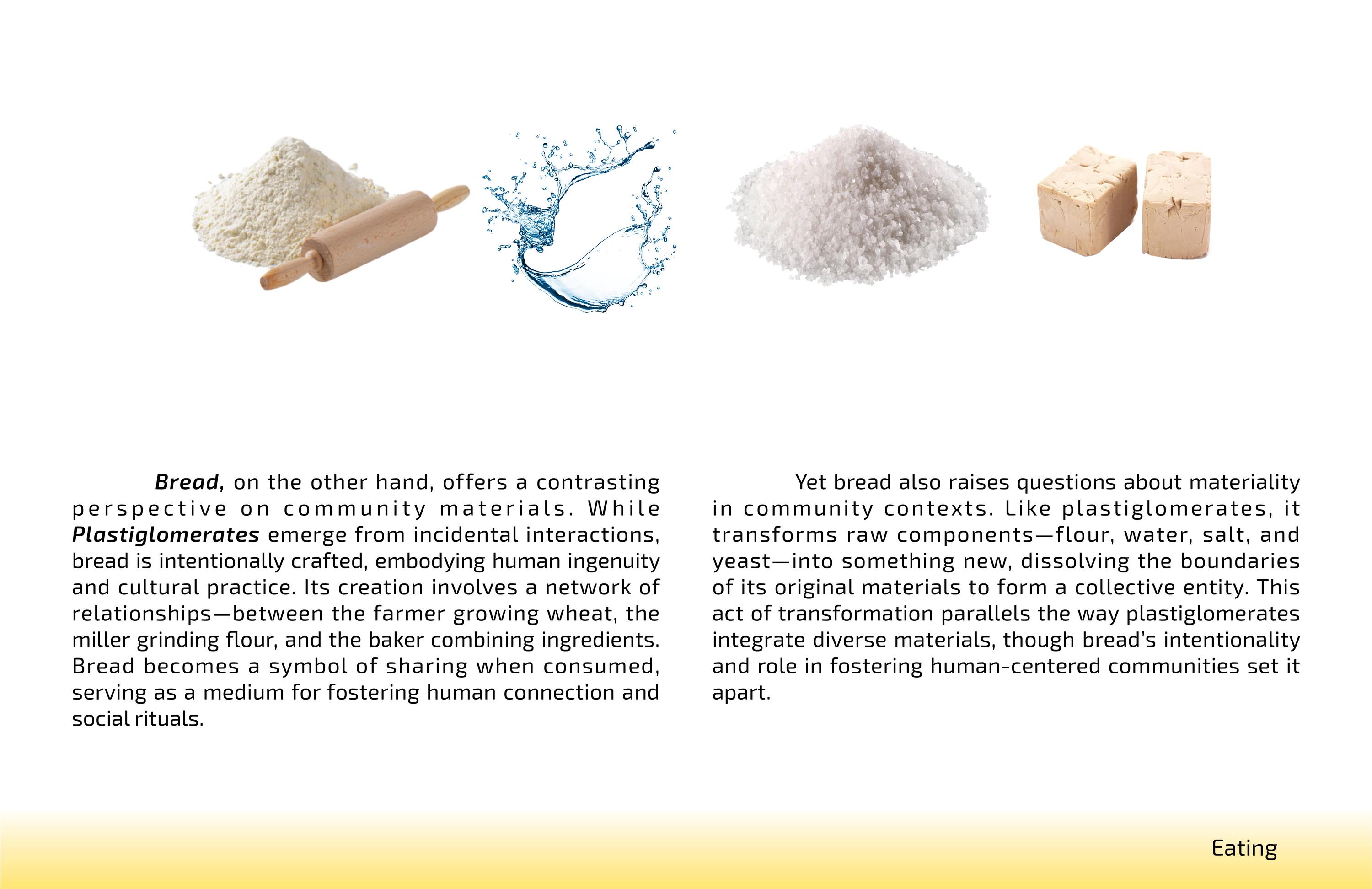
Community Material and Public Translation
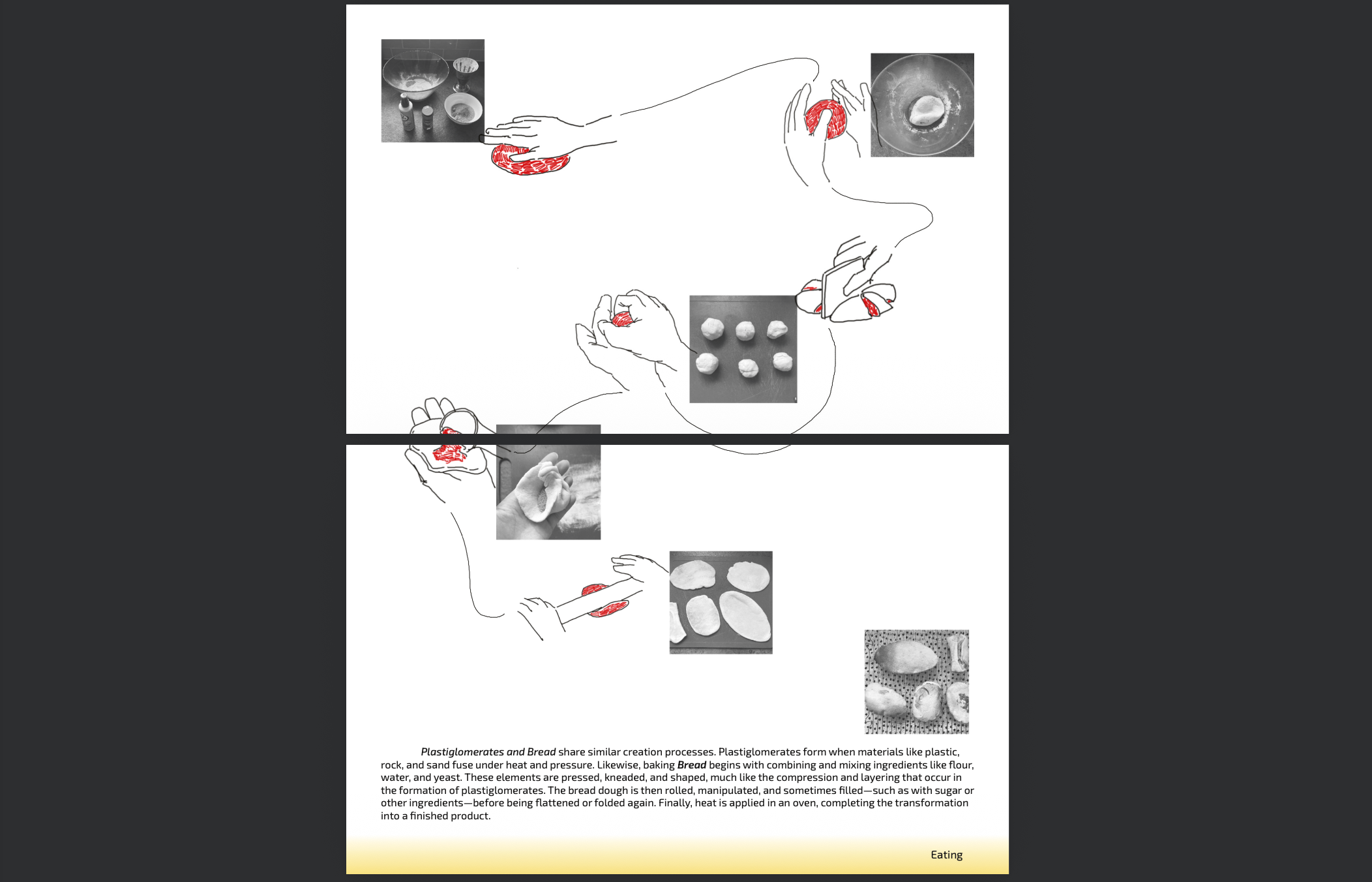
The research compares plastiglomerate with bread as two different forms of assembled material.
Plastiglomerate is an accidental community material. It is formed through environmental force, human pollution, heat, erosion, and time. Its components coexist physically, but not necessarily through care, intention, or solidarity. It is a community formed through proximity, damage, and circumstance.
Bread, by contrast, is an intentional community material. It is made through gathering, mixing, kneading, baking, and sharing. Its ingredients lose their individual boundaries, but they do so through a cultural process that creates nourishment and social connection.
By placing plastiglomerate and bread side by side, the project explores two versions of material entanglement: one accidental and ecological, the other deliberate and social. This comparison became a method for translating the issue into a local, public-facing design language. Instead of communicating plastic pollution only through data or fear, the project uses shared material experience to open discussion around what future materials are, who they belong to, and how communities might respond to them.
Plastic Futures Roadmap
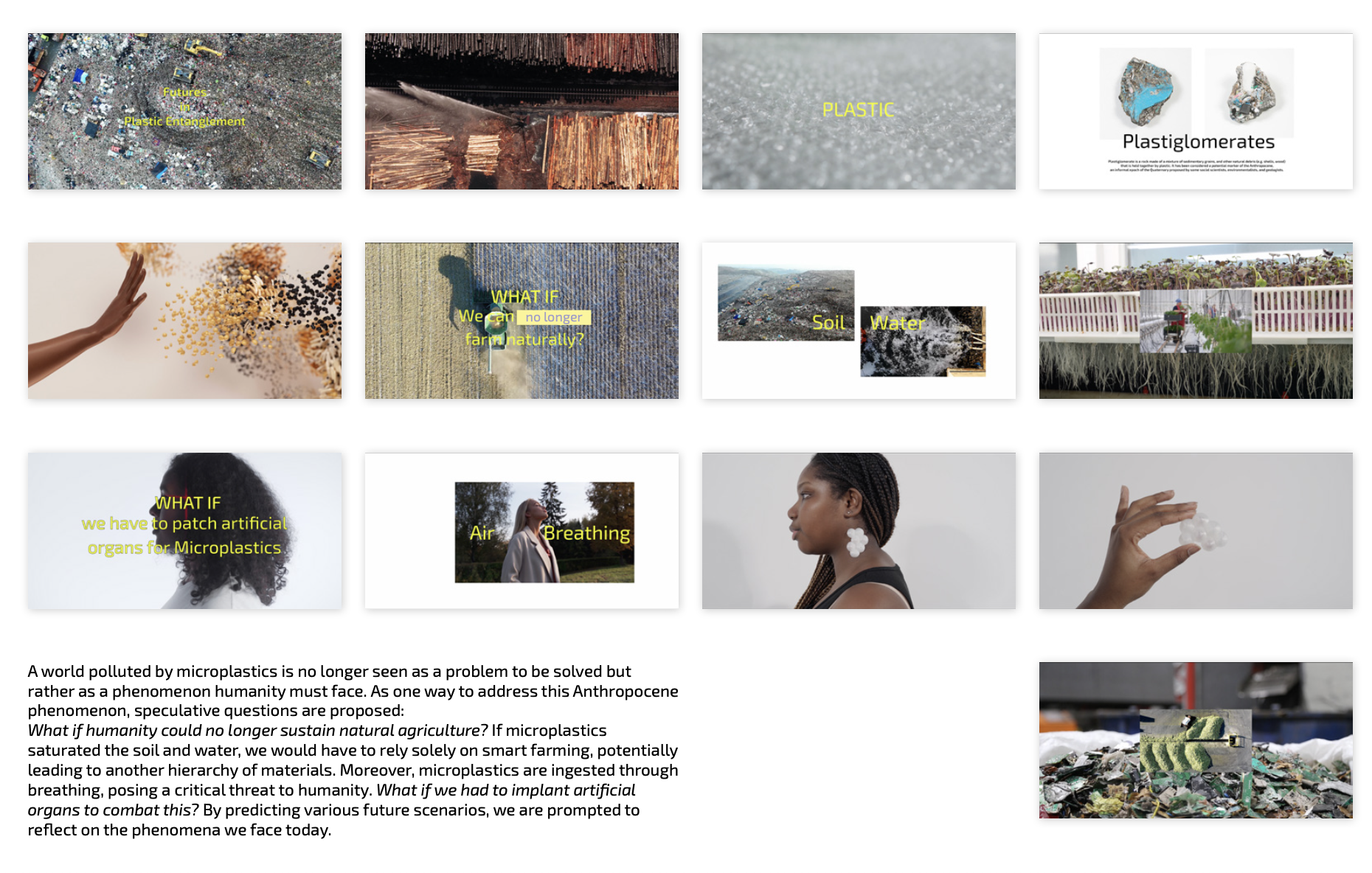
The second phase expands the local material research into a broader future roadmap of plastic entanglement.
If plastiglomerate shows how plastic has already entered geological and ecological systems, microplastics show how plastic may increasingly enter agriculture, food, water, air, and the human body. The project therefore moves from Thames fieldwork to speculative future scenarios involving farming, bodily filtration, smart adaptation, and artificial organs.
The roadmap traces plastic from mass production and synthetic fibres to microplastics, plastiglomerates, future landfills, and bodily accumulation. It uses speculative “What if” questions to map possible consequences: What if natural agriculture could no longer be sustained? What if smart farms became necessary to manage microplastic-free irrigation and soil? What if the value of food depended on its plastic content? What if microplastic accumulation differed by gender, age, or geography? What if future bodies required artificial organs to filter microplastics?
These questions are not predictions. They are design research tools for making current material conditions more confrontable. The roadmap positions plastic not as a single waste problem, but as a long-term infrastructural, agricultural, biological, and social condition.
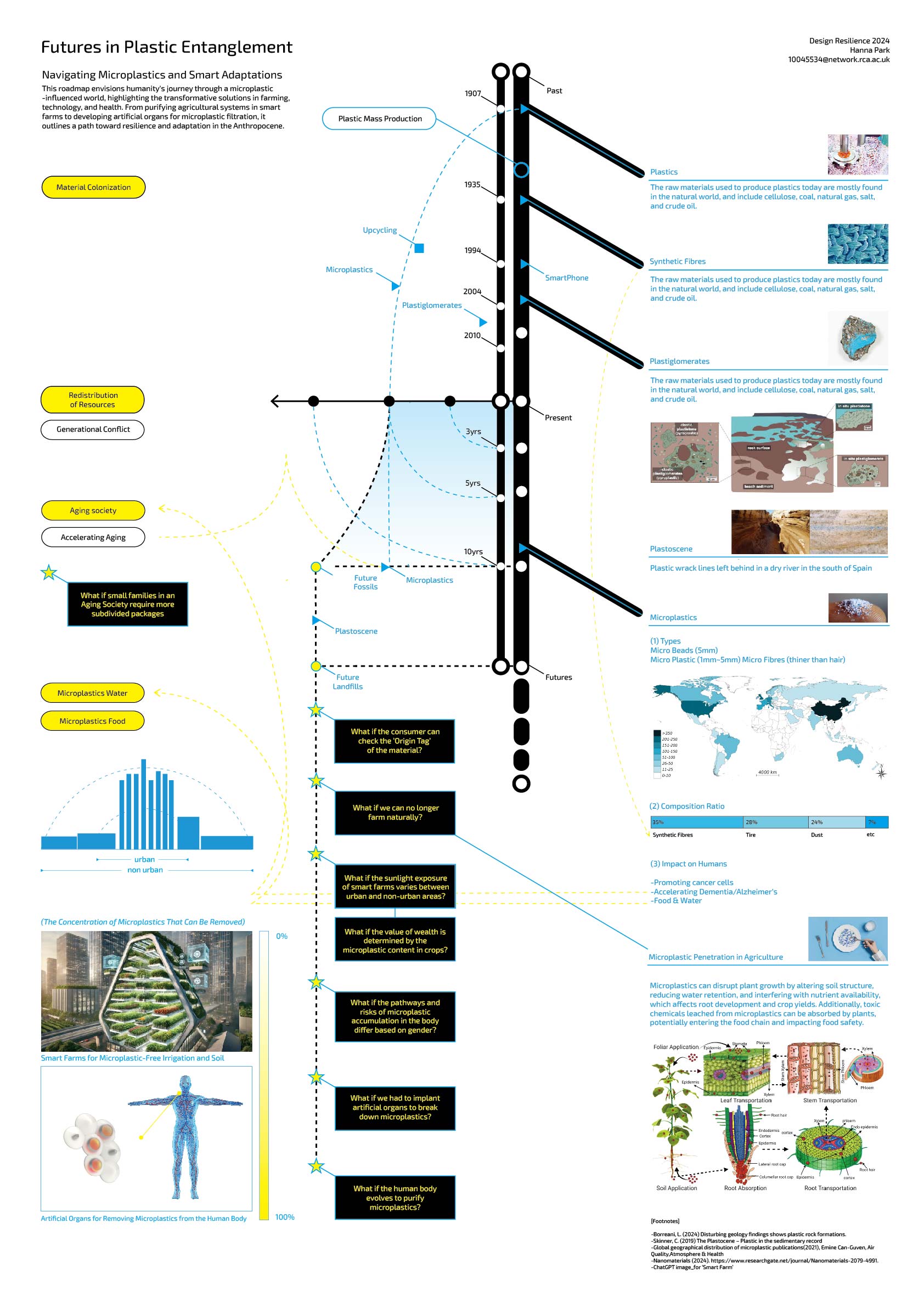
Future roadmap of plastic entanglement, Design Resilience, RCA, 2024
Scenario Film
The project also includes a short scenario film that extends the roadmap into a more experiential future condition.
The film imagines a world in which plastic entanglement is no longer external to the body or environment. Smart farms, microplastic filtration, artificial organs, and adaptive infrastructures become part of everyday life. The scenario does not present these futures as desirable solutions. Instead, it asks what kinds of dependency, inequality, and material hierarchy may emerge if plastic contamination becomes something that society manages rather than prevents.
Through film, the research shifts from diagrammatic forecasting to embodied speculation. It allows the viewer to sense the consequences of plastic futures not only as information, but as a lived condition.
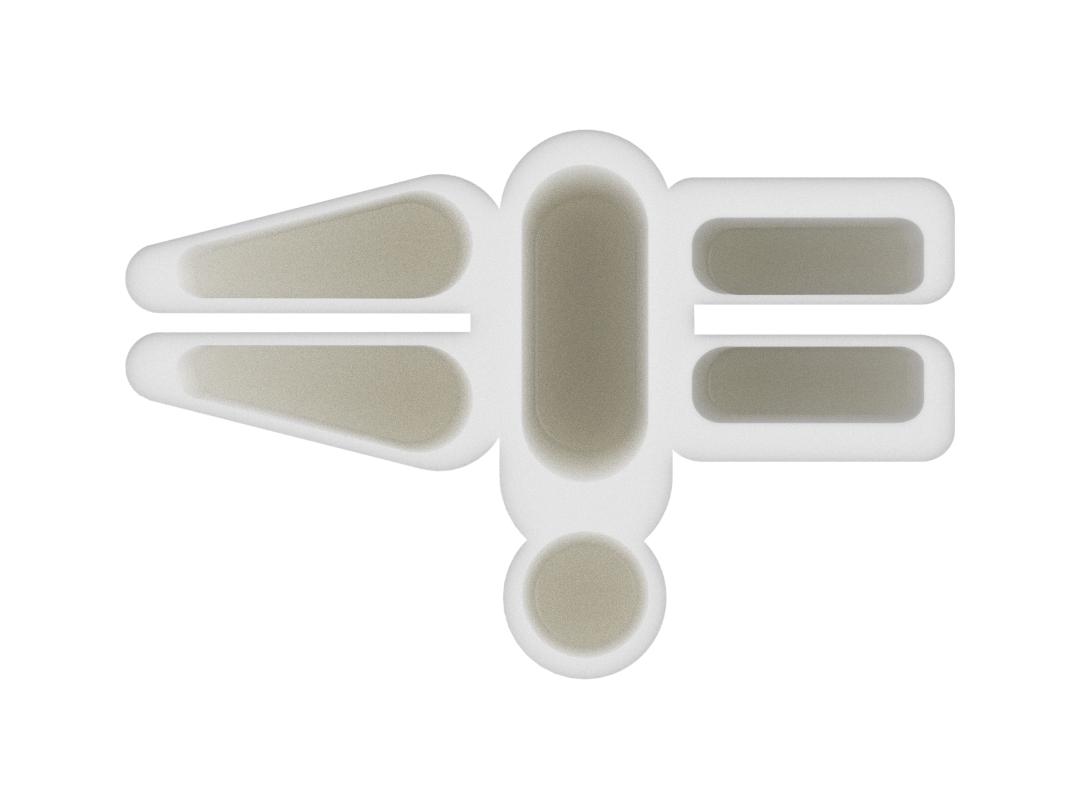
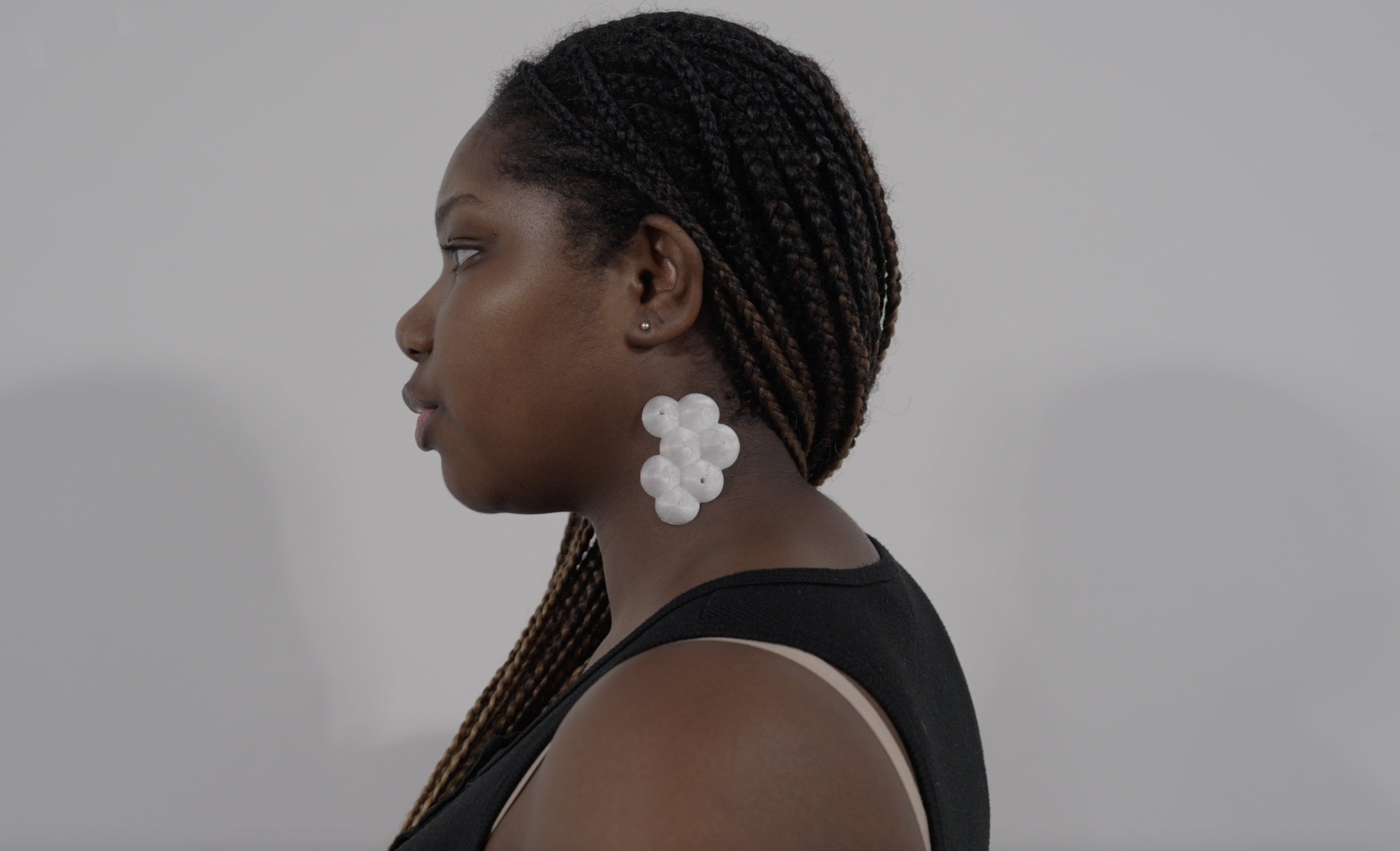
Conceptual prototypes for future organs and microplastic adaptation
Collecting Tools and Romantic Mineralogy
The final extension of the research proposes tools for collecting, classifying, and displaying plastiglomerates and related anthropogenic specimens.
This phase reframes plastiglomerates as future geological inheritances. If rarity has historically shaped the value of gemstones, the project asks what it would mean if plastiglomerates became more symbolically valuable than diamonds. Their value does not come from purity, beauty, or industrial use, but from what they reveal: the entanglement of human desire, industrial residue, ecological damage, and geological time.
The proposed tools are not designed to romanticise pollution. They are designed to help local publics notice, collect, classify, and discuss the materials that plastic culture leaves behind. In this sense, plastiglomerate becomes both a warning material and an educational medium.

Collecting tools for plastiglomerates and anthropogenic specimens
Reflection
Plastiglomerate to Plastic Futures treats plastic not as a distant environmental issue, but as a local material condition already forming around us.
By grounding the research in the Thames, the project avoids treating the Anthropocene as an abstract planetary concept. It begins from a specific site, specific fragments, and specific acts of walking and collecting. From there, it expands into future scenarios of agriculture, bodily adaptation, artificial organs, and material hierarchy.
The project positions design as a method of local environmental translation. It connects fieldwork, archiving, food-sharing, roadmap-making, film, and speculative tool design into one research process. Its central question is not only what future materials will be made of, but how communities will learn to recognise and respond to them.
APPENDIX
Contributors
Researcher — Hanna Park
Designer — Hanna Park
Photographer — Matthew Lee
Model — Dunni
Literature
Patricia L. Corcoran, Charles J. Moore and Kelly Jazvac — An anthropogenic marker horizon in the future rock record (2014)
Timothy Morton — Hyperobjects (2013)
Jane Bennett — Vibrant Matter (2010)
Donna Haraway — Staying with the Trouble (2016)
Heather Davis — Plastic Matter (2015)